Midlife Burnout in Women
Why Rest Fails — and the 3 Powerful Steps to Real Recovery
You’ve rested, you’ve holidayed, you’ve tried everything — and you’re still exhausted. Here’s what’s actually happening, and what genuinely works.
Deborah J Tyson — Kinesiologist & Speaker

Why Midlife Burnout Does Not Improve With Rest
You’ve taken the holiday. You’ve had the early nights. You’ve tried the meditation app. And yet, you wake up on Monday morning feeling exactly the same — flat, foggy, stretched thin — as though the rest never happened at all.
If this sounds familiar, you are not lazy, weak, or failing. What you’re experiencing is not ordinary tiredness, and it cannot be solved by ordinary rest. You are most likely experiencing midlife burnout — a specific, physiological and psychological state that has been building for years, and that the body simply cannot sleep its way out of.
In over 30 years of clinical practice, I have worked with hundreds of women who arrive at my door in this exact state. High-functioning on the outside, quietly exhausted on the inside. Many have been this way for so long they’ve forgotten what it feels like to wake up with genuine energy.
If you relate to the common plight of midlife burnout in women, this article is for you.
What Is Midlife Burnout in Women — and Why is it Different?
Burnout, as defined by the World Health Organisation, is a syndrome resulting from chronic workplace stress that has not been successfully managed. But midlife burnout in women is rarely just a workplace problem. It is the accumulated weight of doing too much, for too long, across every domain of life — professional, relational, domestic, and emotional — with insufficient recovery.
Midlife adds a layer of biological complexity. Between the ages of 40 and 60, most women are navigating significant hormonal change — perimenopause and menopause bring fluctuating oestrogen and progesterone levels that directly affect the brain’s ability to manage stress, regulate mood, and restore energy. What once took a weekend to recover from now takes weeks.
You haven’t lost your capacity. You’ve been running at 120% for too long, and your nervous system has finally run out of buffer.
The Warning Signs that are Often Ignored
One of the most insidious aspects of midlife burnout in women, is how slowly it develops and how easily women normalise its symptoms. The body sends warning signals long before collapse — but those signals are easy to explain away or push through.
Common Early Warning Signs of Midlife Burnout in Women
- Waking unrefreshed despite adequate sleep
- A persistent flatness or emotional numbness — nothing feels exciting
- Difficulty concentrating, remembering words, or making decisions
- Increasing cynicism, irritability, or emotional reactivity
- Physical symptoms without clear cause — headaches, digestive issues, joint pain
- A sense of going through the motions — performing your life rather than living it
- Losing the ability to feel genuinely present with people you love
- An underlying anxiety that never fully switches off, even during rest
Why Rest and Holidays Don’t Work
Rest alone doesn’t resolve midlife burnout in women.
A holiday creates space, but it doesn’t repair the nervous system that’s been running in overdrive for years.
The reason rest fails to resolve burnout is physiological, not motivational. When the nervous system has been in a state of chronic activation — what neuroscientists call a sustained sympathetic stress response — it does not automatically downregulate just because external stressors temporarily disappear.
Think of it this way: if you have been driving a car at high speed for months and the engine overheats, pulling over to rest is necessary — but it doesn’t repair the engine. The mechanical damage has already occurred. You need intervention at the level of the problem of midlife burnout in women, not just a pause in the driving.
Burnout changes the way the body processes cortisol — the primary stress hormone. In later-stage burnout, the HPA axis becomes dysregulated. Cortisol output flattens. The body loses its ability to mount and then resolve a normal stress response. This is why advanced midlife burnout in women, produces that distinctive combination of exhaustion and inability to truly relax.
This is not something a holiday can fix. It requires direct work on the nervous system itself.

The Hidden Layer: Emotional Accumulation
What many mainstream approaches to midlife burnout in women, miss is the emotional component — not emotions in the sense of feelings you can discuss in therapy, but the somatic sense: the physical residue of unexpressed stress, grief, anger, fear, and overwhelm that the body has been storing over years or decades.
Midlife burnout in women is not a character flaw or a failure of willpower. It is the body’s honest accounting of everything it has been asked to carry without adequate support.
What Actually Helps: Addressing the Root Causes
Effective recovery from midlife burnout in women requires working simultaneously at 3 levels:
1. The physiological (the nervous system and the hormonal),
2. The emotional (clearing what the body has been holding),
3. The psychological (the beliefs and patterns that led to the burnout in the first place).
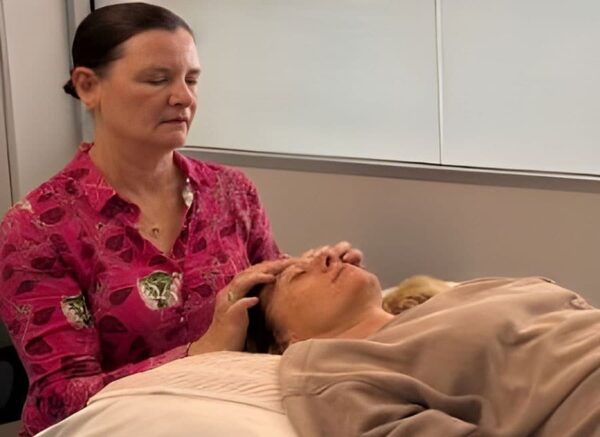
This is precisely what kinesiology does. Using gentle muscle testing — a form of biofeedback — kinesiology identifies where the body is holding stress and imbalance, then works directly with the nervous system using acupressure, sound therapy, vibrational techniques, and approaches drawn from NLP, theta healing, counselling, and psychotherapy.
What kinesiology addresses in burnout recovery
• Nervous system dysregulation • Stored emotional stress • Hormonal and adrenal imbalance • Limiting beliefs driving overperformance • Physical tension patterns • Sleep and energy disruption • Loss of identity and purpose • The anxiety that won’t switch off
The Recovery Timeline for Midlife Burnout in Women: What to Expect
Most women notice something shift within the first one or two sessions — not a complete resolution, but a tangible quieting. A small but unmistakable sense that something has been released.
The Three Phases of Burnout Recovery:
- Phase 1 — Stabilisation (Sessions 1–4): The nervous system begins to downregulate. Sleep often improves. The internal noise quiets.
- Phase 2 — Clearing (Sessions 5–10): Deeper layers of stored stress are addressed. The beliefs and identities that drove the overperformance begin to shift.
- Phase 3 — Recalibration (Sessions 11+): Energy returns. Clarity rebuilds. A grounded, genuinely resourced capacity to re-engage with life emerges.
A Note on Identity: Who Are You Without the Exhaustion?
Rediscovering identity beyond midlife burnout in women.

The midlife question “Who am I without the doing?” is not a crisis. It is an invitation.
For many women, the relentless doing has been a way of proving worth — to themselves, to others, to a professional world that doesn’t make room for vulnerability. When the body finally says “no more,” a profound question surfaces: if I am not achieving, producing, and managing — who am I?
This is not a crisis. It is an invitation. The midlife years carry a genuine developmental gift: the opportunity to shed the accumulated performance of the first half of life and discover what is actually true for you.
Kinesiology supports this process at every level — clearing the physical and emotional residue of the past, stabilising the nervous system, and shifting the beliefs that have kept you in doing-mode long past its usefulness.
You Don’t Have to Keep Pushing Through
If you have been pushing through for longer than you want to admit — if rest doesn’t restore you, if you feel more like a version of yourself than the real thing, if you are quietly wondering how much longer you can sustain this — it is time to take what’s happening seriously.
Not with another productivity strategy. Not with another supplement or sleep app. But with real, root-level support for the nervous system and the whole person that it is running.
You don’t have to keep going like this. Book a free 15-minute call with Deborah — and let’s find out what your body has actually been trying to tell you and discover if kinesiology is a good fit for you.

Deborah J Tyson — Kinesiologist, Speaker & Founder of Blisspot
Deborah J Tyson has been practising kinesiology for over 30 years from her clinic in Neutral Bay, Sydney. She specialises in midlife burnout, deep stress, and emotional recovery for women. She is also an award-winning international keynote speaker and the founder of Blisspot, a global wellness platform. In-person sessions in Sydney; online sessions worldwide.

Kinesology
Ready to Address the Root — Not Just the Symptoms?
Book a free 15-minute call with Deborah to share what you’re experiencing and find out whether kinesiology is the right fit for you. No obligation. No jargon. Just a real conversation about what’s possible.